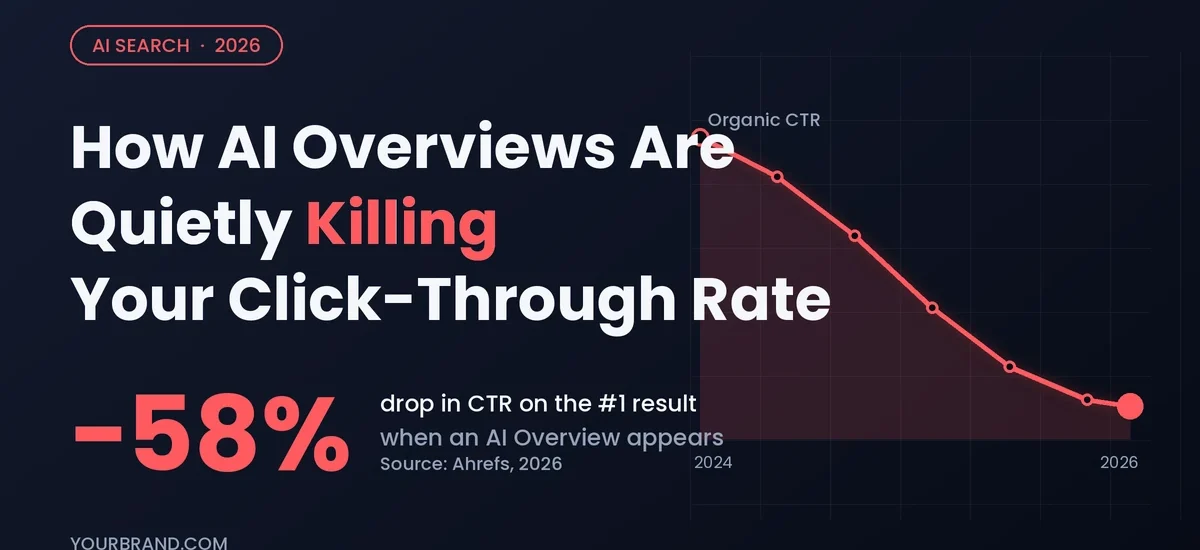
Your rankings look fine. Your impressions are steady, maybe even up. But clicks keep sliding, and the cause is sitting right at the top of the search results page: the AI Overviews click-through rate problem. When Google answers a query inside an AI Overview, fewer people scroll down to your link, even when you hold the number one spot. This is the click side of a wider shift covered in our SEO and GEO playbook for 2026, and this article breaks down what the data actually shows, why your best-ranked pages bleed the most traffic, and the concrete moves that still earn clicks.
The short answer
Yes, AI Overviews reduce click-through rate. Across more than a dozen studies, the presence of an AI Overview lowers organic CTR by anywhere from roughly 15% to nearly 90%, depending on the query type and how it is measured. The hit lands hardest on top-ranking, informational, non-branded pages. The direction is consistent across every credible study: when an AI Overview appears, clicks go down.
AI Overviews CTR drop at a glance
| Source | Measured CTR drop | Scope |
|---|---|---|
| Ahrefs (Dec 2025) | ~58% on the #1 result | When an AI Overview is present |
| Seer Interactive | ~61% organic, ~68% paid | Informational queries with AI Overviews |
| Pew Research | ~46.7% relative decline | Pages with vs. without AI Overviews |
| Amsive | ~15.5% average (up to ~37%) | Larger when combined with featured snippets |
| Ahrefs (Apr 2025) | ~34.5% on the #1 result | Earlier U.S. rollout window |
Figures are drawn from published industry and research studies; see linked sources throughout.
Do AI Overviews reduce clicks? What the data shows
The clearest signal comes from Ahrefs, whose December 2025 analysis found that an AI Overview on the results page cut the click-through rate of the top organic result by about 58%. That was a sharp acceleration from their April 2025 study, which measured a 34.5% drop on position one across 300,000 keywords.
Seer Interactive put the organic decline even higher, around 61% for informational queries, with paid CTR falling about 68% on those same searches. A separate Pew Research finding pointed to a 46.7% relative decline in click rate when an AI Overview was present compared with queries without one.
The studies use different samples and windows, so the exact percentage varies. What does not vary is the conclusion: every study measuring CTR impact found a decline when AI Overviews appear. That unanimity matters more than any single number.
Why position 1 gets hit the hardest
The instinct is that ranking first protects you. With AI Overviews, the opposite is closer to the truth. The Overview occupies the space above the traditional results, so the first organic link gets pushed down and pre-empted. The searcher often has their answer before your blue link enters their field of view.
This is why top-ranked, informational pages report the steepest losses while branded and transactional queries hold up better. If your traffic comes from “how,” “what,” and “why” searches, you sit in the exact zone AI Overviews are built to satisfy. Amsive’s data showed the damage compounds when an AI Overview stacks on top of a featured snippet, pushing the drop toward 37% in those overlap cases.
The zero-click search economy
AI Overviews accelerate a shift that was already underway. Roughly 60% to 65% of Google searches now end without a single click to any website. The search result has become the destination, not the doorway.
That reframes what a “good” CTR even means. Total clicks are shrinking, but the clicks that remain tend to come from higher-intent users, people who read the AI summary, still wanted more, and chose to dig deeper. Those visitors often convert at better rates than a typical organic click. Fewer clicks does not automatically mean weaker performance; it means the value is concentrating into a smaller, more qualified pool.
Cited but clickless: the new trap
Here is the part that surprises most teams. You can be cited inside an AI Overview and still earn almost no clicks. Being the source Google quotes is not the same as being the page Google sends traffic to.
Pages cited in an AI Overview do get more clicks than uncited pages on the same results page, but both still get fewer clicks than they would on a search with no Overview at all. Google’s February 2026 link-visibility change reshuffled this further, giving some cited sources prominent placement while tucking others into expandable sections.
The takeaway: citation is now a brand-awareness channel as much as a traffic channel. When your name appears in the answer, you gain recognition and influence even without the click. You can measure that effect through branded search lift rather than raw sessions.
Is AI Overviews CTR starting to recover?
The picture is not purely bleak, and good content should say so. Seer Interactive reported that CTR on AI Overview results bottomed out at 1.3% in December 2025, then climbed to 2.4% by February 2026, an 85% jump in two months.
Two forces explain the rebound. First, users are learning when to trust an AI summary and when to verify, which sends some of them back to clicking. Second, searches without AI Overviews are becoming more valuable, with their CTR rising as Overviews absorb the quick-answer queries and leave the deeper, click-worthy intent to traditional results. The slide may be leveling off, but clicks lost to quick-answer queries are unlikely to fully return.
How to recover traffic lost to AI Overviews
You cannot opt out of AI Overviews, but you can change what you optimize for. Here is where to focus.
- Target queries that resist summarization. Comparisons, opinion, original data, and decision-stage questions are harder for an AI to resolve in two sentences. Shift effort toward intent an Overview cannot fully satisfy.
- Write to be the cited source. Lead each section with a direct, 40-to-55-word answer, back it with a statistic and a source, then expand. This “answer capsule” structure is what AI systems pull from.
- Add information an Overview cannot replace. Proprietary data, real examples, frameworks, calculators, and expert commentary give the reader a reason to click past the summary.
- Change your success metrics. Track visibility and share of voice, citation frequency, and branded search lift alongside clicks. Measuring only sessions will make a healthy strategy look like a failure.
- Strengthen brand demand. As clicks fragment, the brands people already know get chosen inside AI answers. Investment in recognition pays back in citation share.
For the deeper playbook on getting referenced by AI engines, see our guide on building content that AI search cites and our breakdown of the SEO and GEO playbook. If your clicks are dropping but you are unsure how much is AI Overviews versus other causes, start with our Google Search Console traffic-diagnosis walkthrough.
Frequently asked questions
Do AI Overviews hurt click-through rate?
Yes. Every major 2026 study found that organic click-through rate falls when an AI Overview is present, with reported drops ranging from about 15% to nearly 90%. The impact is largest on top-ranking, informational, non-branded queries, where the Overview answers the searcher before they reach your link.
How much do AI Overviews reduce clicks?
It depends on the query and the study. Ahrefs measured a roughly 58% drop on the number one result in December 2025, Seer Interactive reported about 61% on informational queries, and Pew Research found a 46.7% relative decline. The consistent pattern is a meaningful reduction whenever an Overview appears.
Why is my CTR dropping in Google Search Console?
If impressions hold steady or rise while clicks fall, an AI Overview is likely answering your queries on the results page. Check whether your affected keywords are informational and whether they trigger an Overview. Rankings can stay strong while CTR drops, which is the signature pattern of this shift.
Can you still get clicks if you are cited in an AI Overview?
Sometimes, but fewer than before. Cited pages earn more clicks than uncited pages on the same results page, yet still fewer than they would on a search with no Overview. Treat citation as a brand-awareness and influence channel, and measure it through branded search lift rather than sessions alone.
How do I recover traffic lost to AI Overviews?
Shift toward queries that resist summarization, structure content as citable answer capsules, and add value an Overview cannot replicate, such as original data and expert insight. Just as importantly, broaden your metrics to include visibility, citation share, and branded search so a sound strategy is not judged on raw clicks alone.
Are AI Overviews bad for SEO?
They change SEO rather than end it. AI systems still rely on strong, crawlable, well-structured pages to source their answers, so classic SEO fundamentals continue to drive visibility. The goal simply expands from earning the click to also earning the citation.
Conclusion
AI Overviews are not killing search; they are changing the currency. The metric quietly shrinking is the raw click, and chasing it alone will leave you optimizing for a number that no longer reflects your real reach. Win the citation, capture the higher-intent clicks that remain, and measure visibility, not just sessions. The sites that adapt their scorecard now will look healthy a year from now, while the ones still counting only clicks will keep wondering where their traffic went.
Your rankings can look healthy while your clicks quietly disappear. [Brand] runs a free AI Visibility Audit that shows exactly which of your queries trigger AI Overviews, how much CTR you’re losing, and where you’re already being cited. Get your free audit →
